
Chapter 33: The Real Doubling
“Our daughter exists because love refused to be contained by death.”
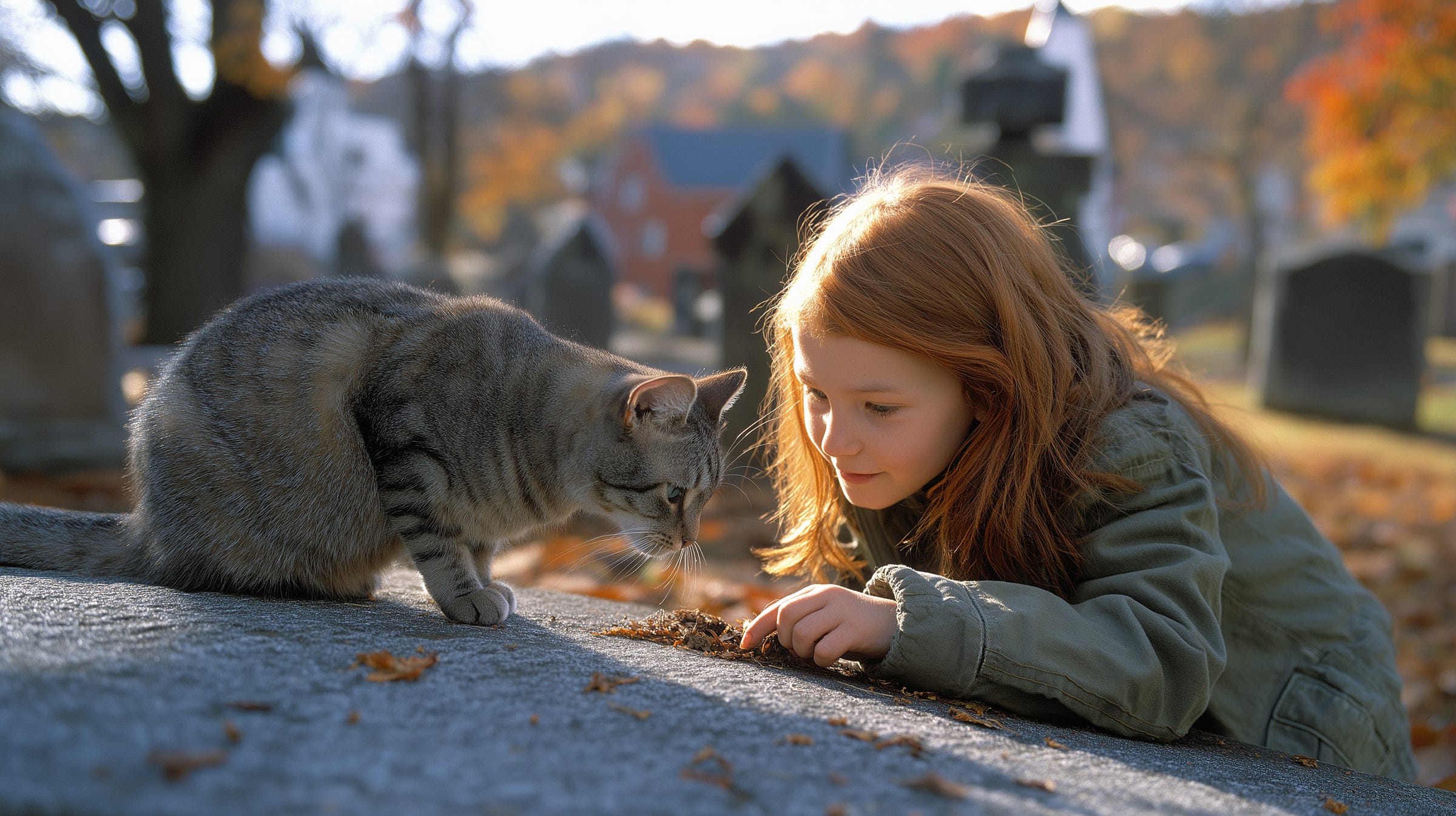
Seven Years Later…
The Millbrook Cemetery sprawled across the hillside of Little Wachusett, where maples blazed scarlet and gold under the patchy gray and blue sky. Weathered slate headstones leaned at tired angles without pattern or plan, while the newer graves settled into neat rows with their sharp inscriptions and faces polished to a mirror finish.
Vera parked the car where the gravel path ended, checked the rearview mirror, and smiled. As usual, Lizzie had already freed herself from the car seat like a six-year-old Houdini-in-training.
“Ready, baby?”
“Do we have to stay long? Auntie A said we could watch The Great Muppet Caper together.” Lizzie clutched a bouquet against her chest that they had picked before getting into the car. White Nippon daisies mostly, and a few purple-somethings for color. The kid had insisted on picking them herself, having rejected the thought of supermarket roses because “daisies are happy flowers.”
“Don’t worry, we won’t be long.”
They got out and walked between the graves while the sun-warmed breeze sent leaves dancing around their feet. Lizzie marched ahead with that Barrett determination in every step. Her auburn hair caught the sunlight like copper wire, not unlike her own shorter cropped cut she’s been doing these days.
“Why are we here, Mama?”
“It’s someone’s birthday.”
“How old?”
Vera didn’t even have to think. “A hundred and forty-one.”
“That’s really old!”
“Yeah, baby. Really old.”
Vera turned left at the third row and followed the familiar path. She’d made this walk half a dozen times, always alone. Today was different. Lizzie bounced beside her, eyes wide at the variety of monuments. She stopped in front of one gravestone that was leaning far to the left.
“Look! What’s that scary face?”
“Death’s heads,” Vera explained as Lizzie pointed to the carving of a skull with wings. “People used to carve those to remind everyone that death comes to all of us.”
“That’s creepy.”
“Maybe, but honest.”
They climbed the gentle slope toward the newer section. Vera’s steps slowed as they approached the spot. Two years ago, an ice storm had felled three massive oaks that she, Sara, and Annie used to gather under while Sara called the Corners — or tried to. The maintenance crew had cleared the trunks but left the stumps. Now the graves sat in full sunlight and now enjoyed a view of the town spreading out below through the gap in the treeline.
(How many times did we sit right here? How many stolen cigarettes did I smoke on this exact spot?)
She remembered those afternoons when they were fifteen, sixteen. Annie perched on the lowest branch like a redheaded oracle, legs and painted Keds with bright socks swinging while Sara attempted her séances. Vera always chose the ground, back against the trunk, ankles crossed, cigarette stolen from her mother’s purse burning between her fingers. The tree had been ancient even then, its roots probably disturbing graves that were older than the country itself.
Annie had fallen once the summer before senior year. Tumbled right off that branch onto the grass below. She’d blamed the tree, called it a “traitorous old bastard” and refused to climb it again. They’d all switched to sitting on the ground after that, forming their little circle in the shade, never knowing they were probably sitting on someone’s ultimate resting place.
(I probably sat on your grave a hundred times, didn’t I? Ashed my cigarettes right on top of you.)
“Is that where we’re going?” Lizzie asked, following her mother’s gaze.
“That’s right, baby.”
They stopped in front of one stone. It was simple. Gray granite, modest. The standard sort when families wanted dignity without ostentation. Clean lines, basic lettering, no decorative flourishes. It looked exactly like what it was — the last marker for a man who had outlived his era by decades but never lost his humility.
WILLIAM JEFFERSON BARRETT
OCTOBER 12, 1890 — AUGUST 31, 1982
BELOVED HUSBAND AND FATHER
“THE DUSKDANCERS REMEMBER”
Lizzie looked around. “It’s so pretty here.” She squatted and placed the bouquet at the base of the stone, arranging each stem just so. Wild daisies had already claimed the edges of the plot, pushing through the tangled grass in defiant clusters.
“Happy Birthday!” she suddenly shouted. She stood up straight and cleared her throat. The birthday song rang out clearly and off-key across the hillside. She sang slowly, carefully, as if each word mattered. When she got to the name part, she sang out “dear Daddy!” extra loud, startling the heck out of Vera.
“Lizzie, sweetie, what — ”
“Auntie A told me my daddy was buried here, and he has the same name as us.” She pointed a small finger at “Barrett.” “She said today was his birthday and we should sing to him.”
(Annie, of course.)
She felt a flash of annoyance. She’d planned this conversation carefully, had practiced what she’d say. Annie meant well, but this was delicate territory.
“I wanted to explain that myself.”
“Are you mad at Auntie A?”
Vera looked at her daughter’s serious blue eyes. William’s eyes, passed down like an heirloom. “No, I’m not mad. She loves you. Sometimes, people who love us try to help even when we don’t ask.”
Lizzie finished her song, complete with the “and many more” verse Annie no doubt had taught her, jazz hands and all.
Just then, a gray tabby emerged from behind a nearby headstone at the end of the row. It watched them through blue eyes, tail twitching as it crept a little closer.
“Mama, look! A kitty!”
The way afternoon light caught the cat’s eyes, the focused intensity, the patient waiting. All of it so familiar.
“Can I pet him?”
“You can try. Be gentle.”
Lizzie approached the cat slowly, hand extended. The tabby sniffed her fingers before rubbing its head against her palm. She giggled and settled cross-legged on the grass, letting the cat climb into her lap.
Vera turned back to the stone. The cemetery fell silent except for Lizzie’s soft murmuring to the cat. She kneeled beside the grave and placed her palm flat against the granite, relishing the warmth from the sun against the cold air.
“So this is her. This is Lizzie.” Her voice came out smaller than she had intended. “Elizabeth Barrett. Your daughter.”
Wind lazily played with the daisies across the plot. Her fingers traced the carved dates, rough granite catching under her nails.
“I’ve read your letters a hundred times. Every birthday, every Christmas, every time I needed to remember.” She pressed her forehead against the stone. “You lived, William. Ninety-three years. Three daughters. A son. Grandchildren who stole cookies and believed your stories about dancing cats. And now you have another daughter.”
Her shoulders shook. She wrapped her arms around herself, rocking slightly on her knees.
“I used to think our time together was too brief, but you taught me something.” She sat back on her heels, wiping her face with the back of her hand. “Time isn’t about duration, because we had forever in those few weeks.”
Fifty feet away, the tabby cat looked up at her. Those blue eyes. Always those blue eyes.
“The circle you described in that last letter,” she laughed, the sound cracking in the middle. “I see it now. Every day. The broken child you comforted became the woman who saved you. Who gave you our daughter. Who sits here now watching the next generation.”
She stood, legs trembling. Her hands found the stone again, palms flat against William’s name.
“I’m not here to grieve. I’m here to say thank you.” Tears streamed down her cheeks. She didn’t bother wiping them away. “For the most impossible love story. You didn’t just love me, my love. Somehow, we bent time. We made love bigger than physics.”
Her grip tightened on the stone.
“Our daughter exists because love refused to be contained by death. She’s here because you chose to live after the magic died. Because you chose to love Sarah. Because you chose to become Pop and complete the circle.”
She kissed her fingertips and pressed them to his name. “Thank you for showing me that some love stories don’t end. They become courage that lives in your daughter’s heart. Magic that dances in shadows. Daisies that bloom despite everything.”
She stepped back, sunlight catching the tears on her face.
“You did it, my love. You kept your promise. You lived. You loved. You danced in the darkness until you found light again.” She smiled through her tears and looked up at Lizzie, who was coaxing the cat with something in her palm. “And now that light lives on in her.”
Uninterested, the tabby cat got up and wandered towards her, Lizzie following close behind.
“I used to sit right here, you know. Before I knew who you were. Annie and Sara and I would come up here as teenagers. Vera smiled at the memory. “We must have had a dozen picnics on this spot. Sara trying to call spirits while I rolled my eyes and Annie made jokes. All those times, and you were right here underneath us. Maybe you were listening. Maybe that’s why Sara could never quite make contact with the other side; you were too polite to interrupt.”
The adjacent stone caught her eye.
ELIZABETH BARRETT
JUNE 3, 1893 — NOVEMBER 14, 1918
BELOVED WIFE AND MOTHER
“UNTIL WE MEET AGAIN”
Beside it, a smaller marker: JACOB BARRETT.
“Hi, Elizabeth.” Vera kneeled between the two graves. “I hope you don’t mind that I named her after you. He talked about you sometimes, when he thought I wasn’t paying attention. The way his voice changed when he said your name. I wanted part of that to live on.”
“Mama!” Lizzie called. “Can we take the kitty home?!”
“No, baby. I don’t think Luna would like that very much.”
“But he’s so cute!”
Vera looked back at Elizabeth’s stone. “He waited for you for so long. Sixty-four years. That’s how much he loved you. I hope you know that. I hope wherever you are, you know he never stopped carrying you with him.”
Lizzie appeared at her elbow, the gray tabby trailing behind. “Who’s this?”
“This is Elizabeth. She was… she was your father’s first wife. A long time ago.”
“Before you?”
“Way before me. Before I was even born.”
Lizzie studied the dates, sounding them out slowly. “Was that a long time ago?”
“It was. There was a sickness that killed a lot of people back then. She and her little boy both got sick, and they couldn’t get better.”
Lizzie bent and pulled a daisy from William’s bouquet and placed it on Elizabeth’s stone. “There. Now she has one, too.” She looked up at Vera. “She has the same name as me.”
Vera kneeled beside her daughter. “That’s right. I named you after her because she mattered to your father. Love doesn’t disappear when someone dies. We carry it forward. We honor it by remembering.”
“But you didn’t know her.”
“No, but I knew how much your father missed her. How he carried her memory for many, many years. When we name children after people who came before, we’re making a promise. We’re saying their story continues. That they’re not forgotten.”
“So we’re like… keeping her alive?”
“You’re keeping her memory alive. Every time someone says your name, this Elizabeth lives a little bit in that moment. Your father would have wanted that. He would have wanted his daughter to carry forward the name of someone he loved.”
Lizzie considered this. “Did they have babies?”
“They had a son. Jacob.” Vera pointed to the adjacent stone. “He died of the illness, too.”
“So, Daddy lost everyone.”
“He did. For a very long time, he was alone. Then he had other children, other families. But he never forgot Elizabeth and Jacob.”
“And then he had me.”
Vera’s throat tightened. “That’s right, baby. But he died before you were born. He never got to meet you.”
“That’s sad.”
“It is. But I think he would have loved you very much.”
Lizzie fidgeted and dug into her pocket. “The kitty liked my crackers,” she said, producing a handful of crushed Goldfish. “They’re kind of gross now.”
“Why do you have those in your pocket?”
“In case I get hungry.” She scattered the biggest pieces on the grass. The tabby cat approached and ate quickly, keeping watch on both of them.
As they stood to leave, the cat walked toward the woods, stopped, and looked back.
“I think she wants us to follow,” Lizzie said.
“We can’t go into the woods right now. We have to get back.”
They walked back toward the car. Lizzie took Vera’s hand, swinging their arms.
“Can we come back next year?”
“You want to?”
“Yeah. To sing happy birthday again. And to visit Elizabeth and Jacob. And to see if the kitty’s still here.”
Vera squeezed her daughter’s hand. “We’ll come every year, if you would like. We’ll make it a tradition.”
“Good.” Then, quick as lightning: “Can we get pizza?”
“Sara’s making lasagna.”
“But I want pizza!” Her whole body slumped. “We never get pizza anymore!”
“We got pizza from Costa’s on Tuesday, silly.”
“That was forever ago!”
“We can ask Auntie Sara to add extra cheese.”
“Pizza has extra cheese, too,” Lizzie muttered, but she climbed into her seat without further protest.
As Vera buckled her in, Lizzie asked, “Is Auntie A going to tell me more things before you want her to?”
Vera laughed. “Probably. That’s what aunties do.”
“Good. I like knowing things.”
Vera kissed her daughter’s forehead. “You’re just like your father that way.”
She closed the door and walked to the driver’s side. Before getting in, she looked back at both graves sitting in the bright sun. The daisies swayed in the wind. The cat had disappeared, but she had the feeling it was still watching from somewhere with its intense blue eyes.
(Thank you for waiting. Thank you for her. Thank you for showing me what love looks like when it’s not afraid.)
In the rearview mirror, Lizzie had already pulled out her travel case of crayons. She bent over her coloring book, tongue poking out in concentration as she stayed carefully inside the lines. Purple first, then blue, then back to purple. She hummed while she colored, some tune Vera didn’t recognize, something that might have been overheard or might have been pure invention.
Vera pulled the Subaru into the driveway and cut the engine. Gravel crunched under the tires as the car settled. Golden light spilled from every window of the house, warm rectangles against the deepening dusk. The engine ticked as it cooled.
Inside, voices layered over each other. Annie’s theatrical complaints rose above the rest.
“That thing you hung in the bathroom looks like Salvador Dali had a seizure!”
Sara’s laughter bubbled through the glass. “It’s abstract expressionism!”
“It’s what happens when paint commits suicide!”
Lizzie bounced in her carseat. “They’re arguing again!”
“They’re not arguing, baby. They’re being themselves.” Vera turned to look at her daughter. “Who do you think wins this time?”
“Auntie A,” Lizzie said without hesitation. “She always wins the art fights.”
“Want to bet a quarter Sara surprises her?”
“Deal!”
Lizzie shot out of the car and slammed through the front door. “AUNTIE A! AUNTIE SARA!”
Annie’s shriek of delight pierced the air. “OH NO! THE KRAKEN IS LOOSE!”
Vera remained beside the car and studied the house. Every board, every shingle, every pane of glass was new. The insurance money from Dominic’s death had rebuilt what fire had stolen. His business partners had wanted the whole mess buried quietly, and Vera had used their guilt money to reconstruct William’s vision exactly.
She’d spent weeks at the town building department digging through old permit files and measuring the foundation that survived the fire. The historical society had a few exterior photos from the 1940s, and she’d hired a preservation specialist to help reconstruct William’s original design. Her contractor had complained about the specifications, but Vera had insisted on building it exactly as she remembered it.
Not for the magic. The Doubling had died with the walls made by William’s hands. Modern materials couldn’t recreate whatever had allowed two times to touch, but she’d needed the rooms to remember their shapes. She needed the staircase to curve where William had once stood, and the kitchen window to frame the woods where the Duskdancers had gathered each night.
The house looked right. It looked like the place where everything had changed.
Inside, warmth and the goodness of homemade cooking hit her immediately. Jack sprawled on the living room floor, probably stretching his back after another long day framing houses. Annie stood over him with her wooden spoon.
“Get up, you lump. Dinner’s almost ready.”
“Five more minutes,” he mumbled.
“VERA!” Sara called from the kitchen. “Tell Annie her so-called artwork belongs in a hazmat facility!”
Vera followed the voices. Sara had made the kitchen feel lived-in already; copper pots on hooks, herbs on the windowsill, rosemary and garlic perfuming the air.
“What am I judging now?”
“The nightmare she hung above the toilet,” Annie said, following Vera in. “It looks like internal organs having an anxiety attack.”
“It’s meant to provoke thought,” Sara protested, checking under the aluminum foil on a casserole dish in the oven.
“The only thought it provokes is whether I need therapy after seeing it.”
Vera smiled and let their familiar bickering wash over her. Her shoulders dropped for the first time all day.
“Where’s Chip?”
“Dining room, setting the table,” Sara said. “Still insists on doing it himself even though it takes twice as long with the cane. Can you grab the wineglasses?”
Vera reached up for the glasses and brought them into the next room.
Chip had the table mostly set, his cane hooked on the back of a chair while he eased around the table. “There she is. How was the cemetery?”
“Good. Lizzie sang happy birthday to William.”
“That kid.” He shook his head but smiled. “She’s something else.”
“And she figured out William was her father.”
Chip’s hand stilled on a fork. “How’d she do that?”
Vera nodded toward the kitchen where Annie’s voice carried. “Like she’d known all along.”
Through the window, stars were appearing above the woods.
“ALL HANDS TO THE TABLE!” Annie bellowed. “FEAST IS SERVED!”
Everyone converged on the dining room. Jack had rallied from his floor stretch. Lizzie bounced on her toes as Sara brought out the lasagna with Annie carrying a mound of garlic bread. Chip poured wine with a steadier hand, having learned to balance with one hand on the table. Juice for Lizzie came last.
“Where should I sit?” Lizzie asked.
“Right there between your mom and me,” Annie said. “Best seat in the house.”
The conversation flowed immediately. Chip telling Jack about adapting tools at construction sites. Sara defending her bathroom art while Annie threatened to replace it with a velvet Elvis. Lizzie asking if Luna could eat lasagna.
“Cats shouldn’t eat people food,” Sara said.
“But Luna’s special,” Lizzie protested. “She came from the Duskdancers.”
“All cats think they’re special,” Annie said. “That’s what makes them cats.”
Vera filled wine glasses and watched and listened. Jack reached over to squeeze Annie’s hand between jokes. Chip asked Lizzie about kindergarten with genuine interest despite having heard these stories before. Sara made sure everyone had seconds before they’d finished firsts.
“Mama, watch!” Lizzie had arranged her garlic bread pieces into a structure on her plate. “It’s a house!”
“Very architectural,” Chip said. “You measure that out first?”
“Measure twice, eat once!” Lizzie declared, then giggled at her own joke.
Vera watched her daughter’s hands work, building even when playing. Those small fingers that moved with such certainty. William’s hands in miniature.
Annie started a story about her worst client this week. Jack interrupted with his own tale of construction disasters. Sara mediated while Chip offered commentary.
Lizzie leaned against Vera’s arm. “Mama?”
“Yeah, baby?”
“This is nice.”
Vera looked around the table. The soft light, the easy laughter, the wine warming her chest. No one checking the time or glancing toward the door. No one leaving.
“Yeah. It is.”
Outside, darkness had claimed the yard. Inside, the lights were warm, and the voices were loud. Lizzie yawned enormously, but tried to hide when Vera looked down at her.
“Can we have ice cream?” Lizzie asked from behind a sweater sleeve.
“After you finish your actual food,” Vera said.
“I did! Look!” She’d eaten around her garlic bread house, leaving it standing in a sea of empty plate.
Annie laughed. “Kid’s got a point. That’s architectural preservation.”
“Ice cream for everyone,” Sara declared. “I made chocolate chip cookie dough.”
“You made it?” Jack asked.
“I bought it and put it in a nice bowl. Same thing.”
The laughter rose again. Vera closed her eyes for a moment and listened. This sound belonged here. These people belonged here. She belonged here.
“Mama!” Lizzie tugged her sleeve. “Ice cream!”
“I hear you, baby.”
“With mouse poops?”
Jack looked confused. “Mouse what now?”
Vera mouthed “chocolate sprinkles” and he burst out laughing.
“Don’t push it,” Vera said to Lizzie. “You’re getting beyond your daily dose of sugar.”
Vera smiled and stood to help clear plates. Through the kitchen window, she could see Luna padding across the yard, probably heading to the woods for untold adventures.
Life moved forward in these small moments. Shared meals and arguments and children who built houses from bread. Not through doorways between times, but through doorways between people who’d decided to love each other.
That was the real Doubling; this was the real magic.
And it was enough.
Thank you for reading! For more stories like this, visit www.arcrocker.com